STRENGTHENING EXTENSION-FARMER RELATIONSHIPS FOR SUSTAINABLE AGRICULTURAL TRANSFORMATION
This article highlights the vital role of strong relationships between extension agents and farmers in achieving sustainable agricultural transformation. It emphasizes trust, effective communication, and collaboration as key drivers of innovation adoption, improved productivity, and resilience. The piece also outlines practical strategies to strengthen these connections, ultimately positioning the extension–farmer relationship as a foundation for food security and long-term agricultural development.
FIELD INSIGHTS
Introduction
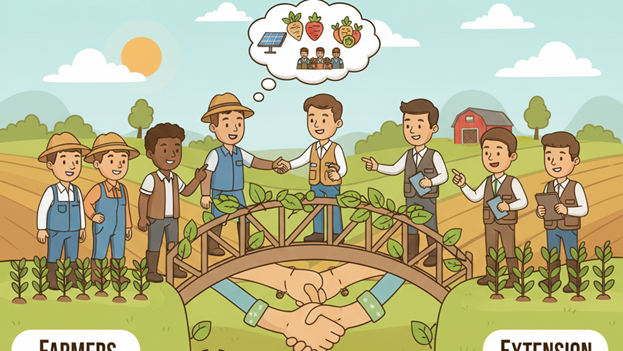
Agriculture remains the backbone of rural livelihoods and national food security, yet the success of agricultural development depends on more than improved seeds, fertilizers or modern equipment. It depends on people. At the centre of this human system is the relationship between agricultural extension agents and the farmers they serve. This relationship is the bridge that connects scientific knowledge to practical action. When the bridge is strong, farmers adopt innovations with confidence, productivity rises, and communities thrive. When the bridge is weak, even the most advanced technologies fail to make an impact.
Across many regions, farmers often express frustration that extension services feel distant, inconsistent or disconnected from their daily struggles. At the same time, extension agents face challenges such as limited resources, large coverage areas and pressure to deliver results quickly. These tensions weaken trust and reduce the effectiveness of agricultural programs. Strengthening the relationship between extension agents and farmers is a strategic necessity for any country seeking to achieve sustainable agricultural transformation.
This brief presents ten comprehensive and practical strategies that can significantly improve this relationship. Each strategy is grounded in real field experiences and is explained in clear language that policymakers, practitioners and community leaders can easily understand. The brief also highlights why strengthening this relationship is essential for long-term agricultural development.
The Importance of Strengthening Extension Farmer Relationships
A strong relationship between extension agents and farmers is essential for several reasons.
First, it increases the adoption of improved technologies. Farmers are more willing to try new practices when they trust the person recommending them. Trust reduces fear of risk and encourages experimentation.
Second, it improves the accuracy and relevance of extension advice. When agents understand farmers' realities, they can tailor recommendations that fit local conditions, available resources and cultural practices.
Third, it enhances resilience. During crises such as droughts, pest outbreaks or market shocks, farmers rely heavily on extension agents for timely guidance. A strong relationship ensures that information flows quickly and effectively.
Fourth, it strengthens community cohesion. When farmers feel supported and respected, they are more likely to participate in group activities, farmer associations and collective marketing efforts.
Finally, it contributes to national food security. Effective extension services lead to higher yields, reduced losses and more stable food supplies.
In short, strengthening this relationship is not only beneficial for farmers. It is essential for the entire agricultural system.
Ten Strategic Actions to Strengthen Extension Farmer Relationships
Build Trust Through Consistency and Honesty
Trust is the foundation of all successful extension work. Farmers quickly lose confidence when agents fail to keep promises or provide information that does not match field realities. Consistency in visits, transparency about limitations and honesty when answers are not immediately available create a dependable relationship. For example, if an agent promises to return with information about a new disease affecting tomatoes, returning on the agreed day with verified information shows reliability. Even if the solution is still being developed, the act of returning builds trust.
Deepen Field Presence to Understand Real Conditions
Extension agents who spend meaningful time on farms gain insights that cannot be captured in reports or office meetings. Observing soil conditions, water availability, labour constraints and local farming practices allows agents to tailor recommendations that are realistic and context-specific. For instance, an agent who notices that a farmer has limited access to labour during planting season can recommend practices that reduce labour demand rather than suggesting labour-intensive innovations that are unlikely to be adopted.
Listen Actively to Farmers' Needs and Priorities
Active listening is more than hearing words. It involves understanding the economic pressures, cultural values and household responsibilities that shape farmers' decisions. When farmers feel heard, they become more open to new ideas. For example, a farmer may reject a new maize variety not because it is inferior but because it matures later and conflicts with the household's need for early food supplies. Listening helps agents avoid assumptions and design better interventions.
Communicate in Local Language and Context
Technical language often creates distance between agents and farmers. Using local languages, familiar expressions, and practical demonstrations makes information more accessible. Visual tools such as simple charts, field samples and locally relevant examples help farmers grasp complex concepts. For example, instead of explaining soil acidity using scientific terms, an agent can show a nearby plot where crops are stunted and explain that the soil lacks nutrients. This approach makes the concept real and easy to understand.
Use Participatory Approaches that Involve Farmers in Decision Making
Farmers are more committed to practices they help design. Participatory approaches such as joint planning, farmer-led trials and collaborative evaluation ensure that innovations reflect farmers' realities. For example, allowing farmers to choose which crop varieties to test in a demonstration plot increases their sense of ownership. When they see the results of their own choices, they are more likely to adopt the successful options.
Respect Farmers' Knowledge and Experience as Valuable Assets
Farmers possess generations of accumulated knowledge about local soils, climate patterns and indigenous crop varieties. Extension agents who treat farmers as partners rather than passive recipients create a more balanced and productive relationship. For example, a farmer may use a traditional method of controlling pests with plant extracts. Instead of dismissing this method, an agent can explore how it can be integrated with modern pest management strategies. This approach strengthens collaboration and mutual respect.
Demonstrate Technologies in Real Farming Conditions
Farmers trust what they can see working in their own environment. Demonstration plots, side-by-side comparisons and farmer-managed trials provide tangible evidence of the benefits of new practices. For example, a demonstration showing yield differences between improved and local varieties on a farmer's own land is far more convincing than a classroom lecture. Farmers can see the results with their own eyes and ask questions based on real observations.
Provide Continuous Follow-Up and Support During Implementation
Initial training is not enough. Farmers often face challenges when applying new practices and require ongoing support. Regular follow-up visits allow agents to correct mistakes, reinforce learning, and address emerging problems. For example, after training farmers on compost preparation, an agent who returns to check the compost pile can help adjust moisture levels, turning frequency and ingredient ratios. This support increases the chances of successful adoption.
Celebrate Local Success Stories to Inspire Wider Adoption
Recognising farmers who successfully adopt innovations motivates others and builds community confidence. Field days, farmer exchange visits and public recognition events create positive peer pressure. For example, showcasing a farmer who doubled yields through improved spacing and timely weeding encourages others to try the same practices. Success becomes contagious when it is visible and celebrated.
Provide Holistic Support Beyond Technical Advice
Farmers face challenges that extend beyond agronomy. Access to markets, credit, inputs and record-keeping tools often determines whether innovations succeed. Extension agents who help farmers link to buyers, financial institutions or cooperatives demonstrate a commitment to farmers' overall livelihoods. For example, helping a farmer group connect with a local buyer for vegetables not only increases income but also strengthens trust in extension services. Farmers begin to see extension agents as partners in development rather than just technical advisors.
Conclusion
Strengthening the relationship between extension agents and farmers is one of the most powerful investments a country can make in its agricultural future. This relationship determines whether innovations reach the field, whether farmers feel supported and whether communities can build resilience in the face of climate change and economic uncertainty. When extension agents are consistent, present, respectful, participatory and supportive, farmers respond with enthusiasm, confidence and commitment. The result is a stronger agricultural sector, improved livelihoods and greater national food security. A strong extension-farmer relationship is essential for sustainable agricultural transformation.